
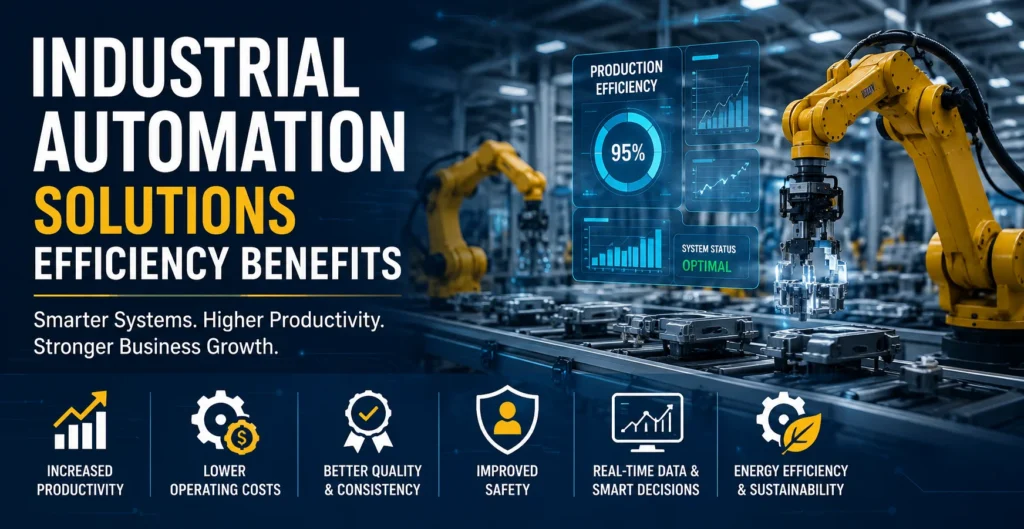
Modern businesses are always looking for ways to work faster, reduce costs, and improve quality. One of the most effective ways to achieve these goals is through industrial automation. From manufacturing plants to warehouses, automation technology is helping companies improve productivity while staying competitive.
In this guide, you’ll learn about the most important industrial automation solutions efficiency benefits, how these systems work, and why many organizations are investing in automation for long-term growth.
- What Are Industrial Automation Solutions?
- How Industrial Automation Improves Efficiency
- Key Benefits of Industrial Automation Solutions
- Reducing Downtime Through Smart Monitoring and Predictive Maintenance
- Data-Driven Decision Making and Process Optimization
- Energy Efficiency, Scalability, and Long-Term Growth
- Challenges to Consider Before Implementing Automation
- Is Industrial Automation Worth the Investment?
- Conclusion
- Frequently Asked Questions
What Are Industrial Automation Solutions?
Industrial automation solutions use technology to perform tasks that were once completed manually. These systems help businesses improve manufacturing operations, increase accuracy, and reduce the need for repetitive human work.
Common automation technologies include:
- Industrial robots
- Industrial sensors
- Programmable Logic Controllers (PLCs)
- Industrial IoT devices
- Automated software systems
- Real-time monitoring tools
Together, these automated systems create a smart manufacturing environment where machines, software, and people work more efficiently. According to the International Society of Automation (ISA), automation plays a key role in improving industrial performance and operational excellence.
How Industrial Automation Improves Efficiency
The main goal of industrial automation is to improve operational efficiency. Businesses can accomplish more work in less time while reducing mistakes and unnecessary costs.
Automation improves efficiency in several ways.
First, it reduces manual work. Machines can perform repetitive tasks faster and more consistently than humans.
Second, automation speeds up production. Automated production lines can operate continuously with minimal interruptions, leading to faster production cycles and increased production output.
Third, automation reduces human error. By following programmed instructions, machines maintain process consistency and improve quality control.
Finally, automation provides real-time operational data. Managers can monitor performance, identify production bottlenecks, and make data-driven decisions that improve overall productivity.
Key Benefits of Industrial Automation Solutions
Increased Productivity and Output
One of the biggest benefits of manufacturing automation is higher productivity. Automated equipment can operate around the clock without fatigue, helping businesses increase production efficiency and manufacturing productivity.
For example, a factory using industrial robots can complete repetitive assembly tasks much faster than a manual workforce. This leads to greater throughput optimization and continuous production.
Better Product Quality and Consistency
Automation helps companies deliver consistent product quality. Automated inspection systems and advanced sensors can detect defects early, reducing the chance of faulty products reaching customers.
Because machines follow the same process every time, businesses achieve better quality control and maintain higher standards across all production runs.
Lower Operating Costs
Many companies invest in automation because it supports cost reduction over time.
Automated systems reduce labor-intensive tasks, improve resource utilization, and minimize material waste. Better asset utilization also helps companies get more value from existing equipment and facilities.
These savings often contribute to a stronger return on investment (ROI).
Improved Workplace Safety
Workplace safety is another major advantage of automation technology.
Machines can perform dangerous or physically demanding jobs, reducing employee exposure to hazardous environments. This helps organizations meet compliance and safety standards while protecting workers from injury.
Reducing Downtime Through Smart Monitoring and Predictive Maintenance
Equipment downtime can be expensive for any business. Unexpected breakdowns often lead to production delays and lost revenue.
Predictive maintenance helps solve this problem.
Using industrial sensors, machine performance monitoring, and predictive analytics, businesses can identify potential issues before equipment fails. Real-time monitoring systems track equipment reliability and alert maintenance teams when service is needed.
This approach improves maintenance planning, reduces downtime, and helps maintain smooth manufacturing operations.
Data-Driven Decision Making and Process Optimization
Modern automation systems generate large amounts of valuable data.
Through performance tracking and real-time operational data, managers can gain deeper insights into production performance. These insights help businesses improve workflow automation, identify inefficiencies, and optimize processes.
For example, if one machine consistently slows production, managers can quickly address the issue before it impacts overall output.
This ability to make data-driven decisions supports continuous improvement and operational excellence.
Energy Efficiency, Scalability, and Long-Term Growth
Industrial automation does more than improve daily operations. It also supports long-term business growth.
Automated systems often use resources more efficiently, helping companies improve energy efficiency and reduce waste. This contributes to sustainable manufacturing practices and lower operating expenses.
Automation also makes it easier to scale operations. As demand grows, businesses can expand production without significantly increasing labor requirements.
In addition, automation supports Industry 4.0 initiatives through connected manufacturing and industrial IoT technologies. The National Institute of Standards and Technology (NIST) highlights the growing importance of smart manufacturing and digital transformation in modern industry.
Challenges to Consider Before Implementing Automation
Although automation offers many benefits, businesses should consider a few challenges before implementation.
Initial investment costs can be significant, especially for smaller companies.
Employee training is also important. Workers need to understand how to operate and maintain new systems effectively.
Finally, organizations must carefully plan system integration to ensure new automation technologies work smoothly with existing equipment and processes.
Addressing these challenges early can improve project success and maximize automation benefits.
Is Industrial Automation Worth the Investment?
For many businesses, industrial automation is a worthwhile investment.
The combination of productivity improvement, cost reduction, improved quality, and enhanced workplace safety often produces strong long-term ROI.
Industries that commonly benefit from automation include:
- Manufacturing
- Automotive
- Food processing
- Pharmaceuticals
- Logistics
- Electronics
Beyond immediate savings, automation creates operational resilience, improves supply chain efficiency, and supports business scalability. These competitive advantages can help companies remain successful in a rapidly changing market.
Conclusion
Industrial automation solutions provide significant efficiency benefits for businesses of all sizes. By reducing manual work, improving production efficiency, enhancing quality control, and supporting data-driven decisions, automation helps organizations operate smarter and more effectively.
While implementation requires planning and investment, the long-term rewards often outweigh the initial costs. Companies that embrace smart manufacturing, predictive maintenance, and Industry 4.0 technologies are better positioned for growth, sustainability, and long-term success.
Frequently Asked Questions
What are the main benefits of industrial automation solutions?
Industrial automation solutions improve productivity, reduce costs, enhance quality control, increase workplace safety, and support faster decision-making through real-time data.
How does industrial automation improve manufacturing efficiency?
Automation reduces manual work, minimizes human error, speeds up production, and helps businesses optimize processes using real-time monitoring and analytics.
Can industrial automation reduce operational costs?
Yes. Automation lowers labor costs, reduces waste, improves resource utilization, and minimizes equipment downtime, helping businesses save money over time.
What industries benefit the most from industrial automation?
Manufacturing, automotive, food processing, pharmaceuticals, logistics, and electronics are among the industries that benefit most from automation technology.
How does predictive maintenance support automation efficiency?
Predictive maintenance uses sensors and monitoring systems to identify equipment problems before failures occur, reducing downtime and improving equipment reliability.
Is industrial automation worth the initial investment?
In many cases, yes. Increased productivity, lower operating costs, better quality, and long-term growth opportunities often provide a strong return on investment.