
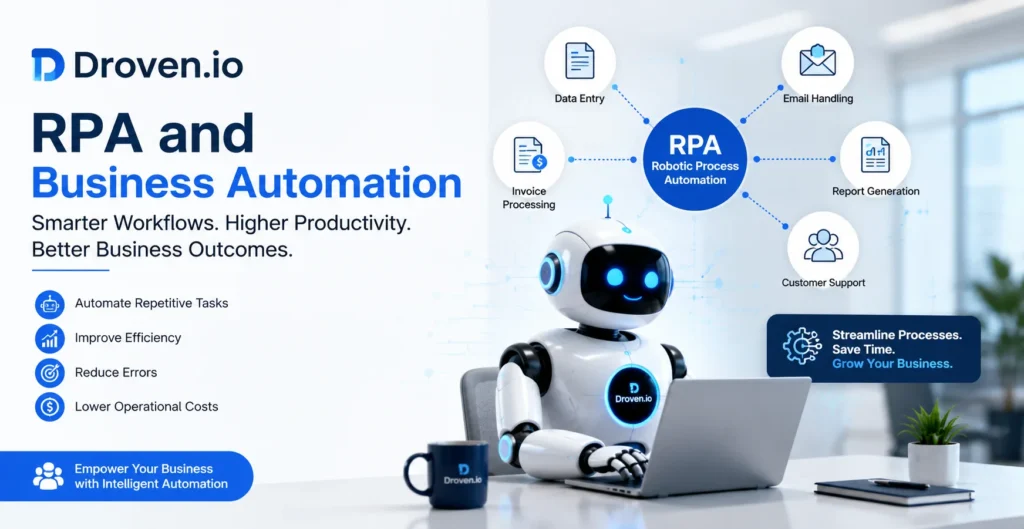
What if the repetitive tasks that slow businesses down could take care of themselves? From entering customer data to sending reports, automation is changing how companies work. Understanding droven.io RPA and business automation can help beginners see why businesses are embracing digital transformation and preparing for the future of work.
- What Is Droven.io and Why Is It Gaining Attention?
- What Is RPA (Robotic Process Automation)?
- How Business Automation Works in Real Organizations
- Key Benefits of RPA and Business Automation
- Real-World Examples of Automation Across Industries
- RPA vs. AI Automation: What's the Difference?
- How Businesses Can Get Started With Automation
- Why Understanding Automation Matters for the Future of Work
- Frequently Asked Questions
What Is Droven.io and Why Is It Gaining Attention?
Droven.io has attracted attention because it focuses on helping readers understand emerging technologies such as AI automation, intelligent automation, and business automation. Many people searching for droven.io want simple explanations rather than technical details.
Some users assume Droven.io is a software vendor that sells RPA solutions. Others view it as an educational resource that explains automation trends and digital innovation. Either way, its growing popularity reflects a larger shift toward technology adoption across industries.
Businesses today are looking for automation tools that improve efficiency while remaining easy to understand. This growing automation ecosystem has encouraged more beginners to learn about enterprise automation and automation readiness.
What Is RPA (Robotic Process Automation)?
Robotic Process Automation, often called RPA, uses software bots to perform repetitive tasks that follow clear rules. Think of software robots as digital workers that handle tasks people would otherwise complete manually.
These rule-based processes might include copying information from one system to another, updating records, or processing forms. Unlike humans, software bots can perform repetitive administrative tasks without getting tired.
RPA focuses on manual task reduction. It helps organizations improve business efficiency while reducing human error. According to IBM’s explanation of RPA, businesses use automation to streamline routine work and improve operational efficiency. You can learn more through IBM’s overview of RPA:
The difference between manual work and process automation is simple. Manual work requires employees to repeat the same steps repeatedly. Process automation allows software bots to complete those steps automatically.
How Business Automation Works in Real Organizations
Business automation involves using technology to improve business operations through automated workflows and workflow management.
The Typical Automation Process
Most automation implementation follows a similar path.
First, organizations identify repetitive tasks through process discovery. They look for activities that consume time and follow predictable steps.
Next, teams design workflows and create an automation strategy. This stage often includes workflow orchestration and planning for exception handling when unusual situations occur.
Then, software bots perform the work. During this automation lifecycle, businesses monitor results, adjust processes, and optimize performance.
This approach supports process optimization while helping organizations build scalable business processes.
Common Tasks Businesses Automate
Many automation use cases involve everyday office activities.
Common examples include:
- Data entry automation
- Invoice processing automation
- Email handling
- Report generation
- Customer service automation
- Record updates
Some organizations also use intelligent document processing to extract information from forms and invoices. These improvements support business process management and free employees to focus on higher-value work.
Key Benefits of RPA and Business Automation
One reason automation adoption continues to grow is the wide range of automation benefits it offers.
Improved productivity is often the first advantage businesses notice. Employees spend less time on repetitive tasks and more time solving problems or helping customers.
Automation also reduces operational costs. Fewer errors mean less rework, which contributes to better operational efficiency.
Human error reduction is another major benefit. Software bots follow the same rules every time, improving compliance and accuracy.
Businesses also enjoy faster turnaround times. Reports can be generated quickly, invoices processed faster, and customer requests handled more efficiently.
Finally, enterprise scalability becomes easier. Automated workflows support business growth without requiring organizations to dramatically increase staffing levels.
These improvements often lead to better customer experience, stronger employee productivity, and a higher return on investment (ROI).
Real-World Examples of Automation Across Industries
Automation is no longer limited to large technology companies. Businesses across many industries use process automation every day.
In finance and accounting, bots process invoices, verify transactions, and prepare reports.
Healthcare administrators automate appointment scheduling, billing updates, and patient record management while maintaining compliance requirements.
Retail and e-commerce businesses use customer service automation to respond to common questions and update inventory systems.
Human resources departments automate employee onboarding and document collection.
Customer support teams use digital workforce solutions to answer routine requests and improve response times.
These examples show how enterprise automation can strengthen business operations while improving customer satisfaction.
RPA vs. AI Automation: What’s the Difference?
Many beginners wonder whether RPA and Artificial Intelligence are the same thing.
The answer is no.
RPA uses rule-based processes. Software robots follow instructions exactly as programmed.
AI-powered automation goes further. Artificial Intelligence can recognize patterns, analyze information, and support decision-making efficiency. Machine learning integration allows systems to improve over time.
Businesses may only need RPA when processes are simple and predictable.
However, more advanced organizations combine RPA with intelligent automation to create hyperautomation. This approach blends cloud-based automation, AI capabilities, and traditional automation tools to automate increasingly complex workflows.
Instead of replacing RPA, AI often enhances it.
How Businesses Can Get Started With Automation
Businesses interested in automation implementation should begin with small steps.
Start by identifying high-volume tasks that employees repeat frequently. These activities usually provide the fastest results.
Set measurable goals and establish ROI expectations. For example, determine how much time you hope to save or how many errors you want to reduce.
Begin with one process before expanding. Early success builds confidence and improves automation readiness.
Employee involvement also matters. Workers often understand existing processes best and can help identify improvement opportunities.
Finally, monitor outcomes regularly. Continuous adjustments support workflow management and long-term success.
Why Understanding Automation Matters for the Future of Work
The future of automation is already shaping workplaces across the United States.
As businesses pursue digital transformation, automation literacy is becoming an important skill. Employees who understand automation concepts can adapt more easily to changing technologies.
Learning about automation does not mean becoming a programmer. It means understanding how technology adoption influences the future of work.
Resources such as Droven.io help non-technical readers explore digital innovation and emerging trends in ways that are easier to understand.
As automation ecosystems continue to evolve, businesses and employees who embrace learning today will be better prepared for tomorrow.
Frequently Asked Questions
What is RPA in business process automation?
RPA stands for Robotic Process Automation. It uses software bots to complete repetitive tasks such as data entry, invoice processing, and report generation. These bots help businesses save time, improve accuracy, and increase productivity.
Is RPA the same as automation?
No. RPA is one type of automation. Business automation includes RPA, AI automation, workflow automation, and other technologies used to improve efficiency across organizations.
What are the four stages of process automation?
The four common stages include identifying repetitive tasks, designing workflows, deploying software bots, and monitoring results for continuous improvement.
What processes are not suitable for RPA?
Processes that require creativity, emotional understanding, or complex judgment without clear rules are generally not ideal for RPA. These tasks are often better suited for humans or advanced AI systems.
Will RPA be replaced by AI?
Probably not. RPA and AI work best together. RPA handles rule-based tasks, while AI supports learning and decision-making. Their combination, known as hyperautomation, allows businesses to automate more sophisticated processes.
What are the top three RPA software platforms?
Three widely recognized RPA platforms are UiPath, Automation Anywhere, and Blue Prism. These solutions help organizations automate workflows and improve operational efficiency.